
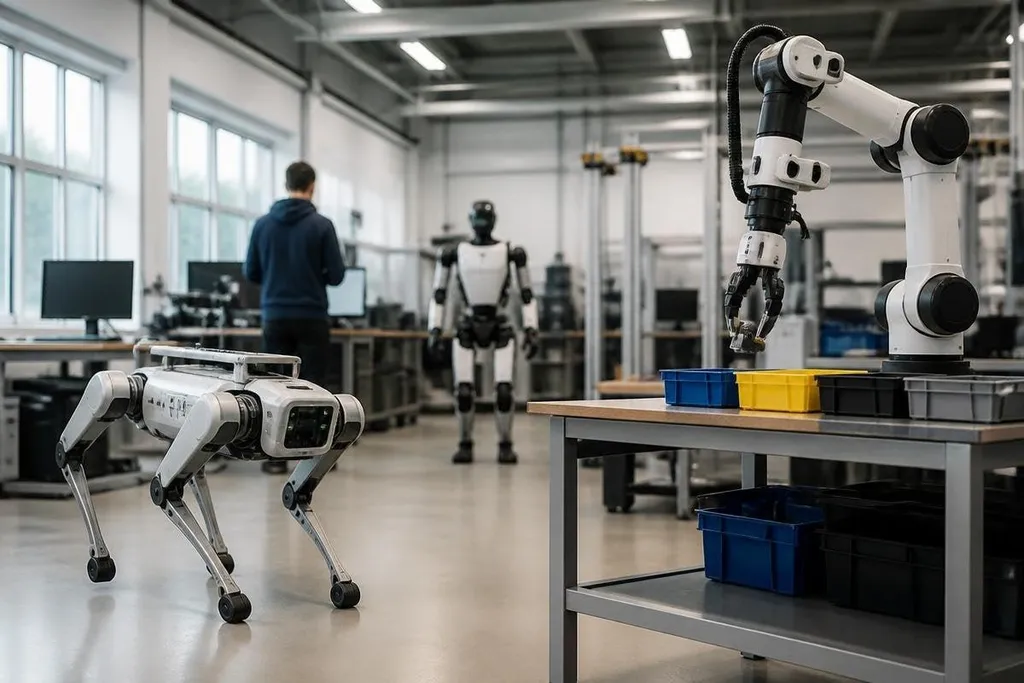
A research robot can walk across a lab, fold a shirt, or sort objects under bright lights. That does not tell you which result matters most outside the test room. To rank major progress fairly, you need a clear task, a repeatable test, and a record of what failed.
- A demo shows one run; a result needs repeatable trials.
- A useful robot must handle changes in objects, surfaces, light, or contact.
- The hardest part to judge is often the limit the team leaves out.
Start with the task, not the robot
Research robotics covers machines with very different jobs. A mobile robot may map a building, while a robot arm may sort parts or learn a new grip. Comparing them by one score produces a list with little use.
The first question is practical: what did the robot do that was hard before? That finding matters more when it removes a known barrier, such as poor balance on loose ground or failed grips on objects the robot has not seen during training.
That task also needs a fixed test. A walking robot should face named surfaces and a stated speed. A manipulation system should report the object set, success rate, number of trials, and the time needed to prepare each run.
A demo is only the first test
Video can show movement, but it rarely shows the full work around that movement. Look for cuts, remote control, resets, human placement of objects, and the number of failed attempts removed from the edit.
A robot that completes one hard action has shown a result. A robot that repeats the action across many trials has shown a system. Those are different claims, and a careful article should keep them separate.
Research demos often leave out the test date, failed runs, and amount of human control. Robot24.com research robotics coverage can put those details beside the lab result, giving you a fairer basis for ranking what each system has shown.
The limits decide the ranking
A paper may report a high success rate while using a narrow set of objects, a clean floor, or a fixed camera. Those conditions do not make the result false. They define where the result has been tested.
The missing details often matter more than the headline.
Check the robot's battery time, payload, sensor setup, compute hardware, operator input, and recovery method. A system that needs a person to reset its arm after every error has a different use from one that can recover by itself.
Cost matters too, even in research. A result that needs a custom robot, a large motion-capture room, and several operators may still help the field. It may not transfer to a small lab or a working site without major changes.
I'd rank repeatable work on varied tasks above a polished demo, even when the demo looks harder.
What counts as a major result
A strong research result usually changes one part of the work in a way another team can check. That change might sit in the robot's body, its control software, its sensors, or the method used to train it.
The evidence should show the old limit and the new result. For a claim that a robot learns faster, the paper should report the training time, the task set, and the comparison method. If the robot uses less energy, the test should state the load, speed, surface, and measurement method.
Open code, public data, and clear hardware details make checking easier. The work can still matter without them, but outside teams have less ability to repeat it or find the point where it fails.
A buyer's and engineer's checklist
Use this list before calling any research result a major step:
- Task: Is the job named in enough detail to repeat?
- Test: Are trials, failures, speed, load, and success rate shown?
- Control: Did a person guide the robot during the task?
- Range: Did the system face changes in objects, surfaces, or light?
- Cost: Are the robot, sensors, compute hardware, and operators listed?
- Access: Can another team get the code, data, or hardware details?
Work that passes these checks earns a place in a serious ranking. Work that fails them can still be worth watching, but its claim should stay narrow.
The next useful list of research robotics breakthroughs will need fewer grand labels and more test records. Until those records arrive, the honest ranking is the one that names the task, counts the failures, and says what the robot still cannot do.